
About Lightning
Lightning is a natural electrostatic discharge between two electrically charged regions — in the atmosphere, or between cloud and ground. It chooses its own path, and it decides in microseconds.
In 2019, Vaisala’s GLD360 network detected 2 353 476 704 lightning events worldwide. Only about 20 % of them were cloud-to-ground — the ones that matter to a building.
A single cloud-to-ground flash peaks at around 10¹² watts for some thirty microseconds — about a thousand times the output of a 1 GW power station — and releases 1 to 10 gigajoules: the energy that same station produces in one to ten seconds.
This page gathers what we have measured and documented — articles, studies and field cases: the physics that decides where a discharge begins, the historical record, and the cases we have handled ourselves.
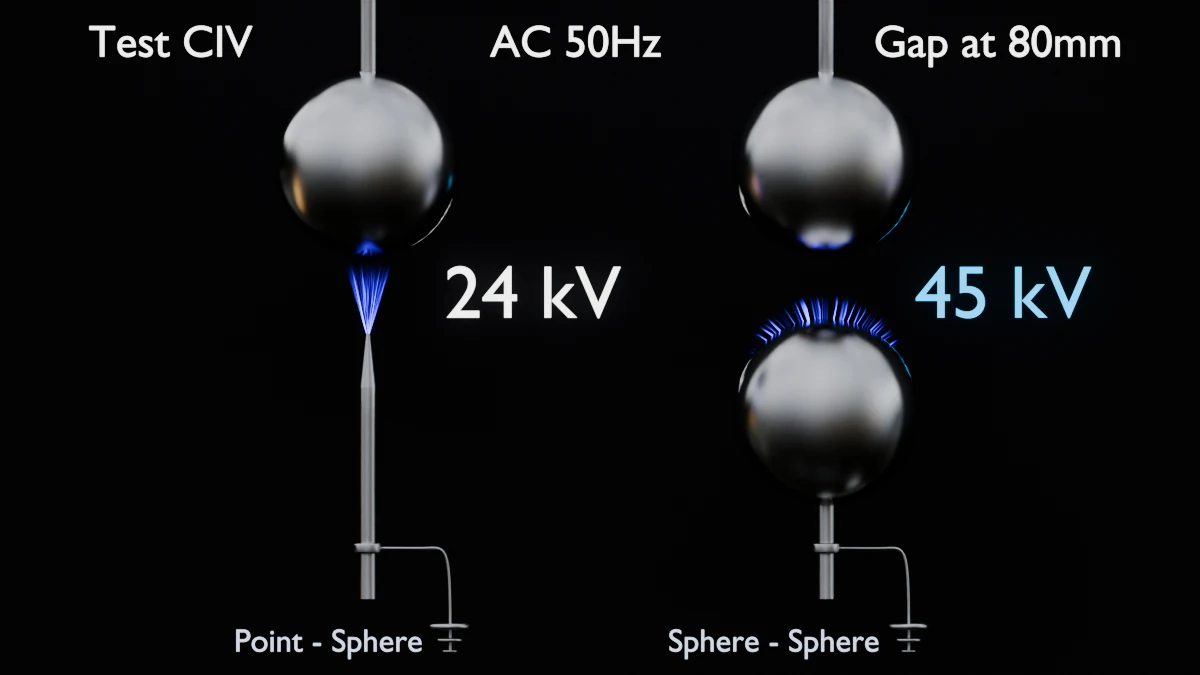
Corona Inception Voltage: Why the Shape of an Electrode Decides When Air Starts to Conduct
A standard sphere gap measures when air breaks down. A 2016 study measured when air starts to ionise: at 80 mm, a point at 24 kV, a 250 mm sphere at 45 kV.
Read the article →How to Make Your House Lightning-Proof in 2025: A SPIN Case Study
A Da Nang residential case study: repeated lightning damage, the repairs, and how Tesla-inspired SPIN protectors are used to prevent strikes.
Read the case study →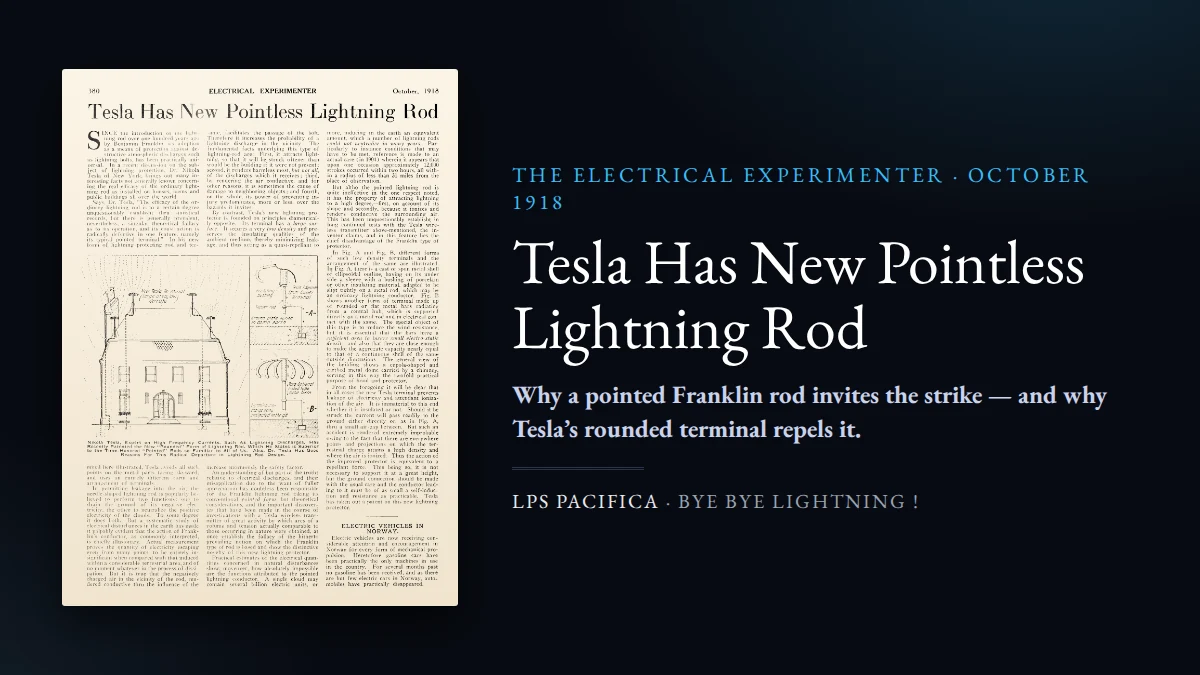
Tesla Has New Pointless Lightning Rod (1918)
The full October 1918 article from The Electrical Experimenter: why a pointed Franklin rod attracts lightning, and why Tesla’s rounded terminal repels it.
Read the archive →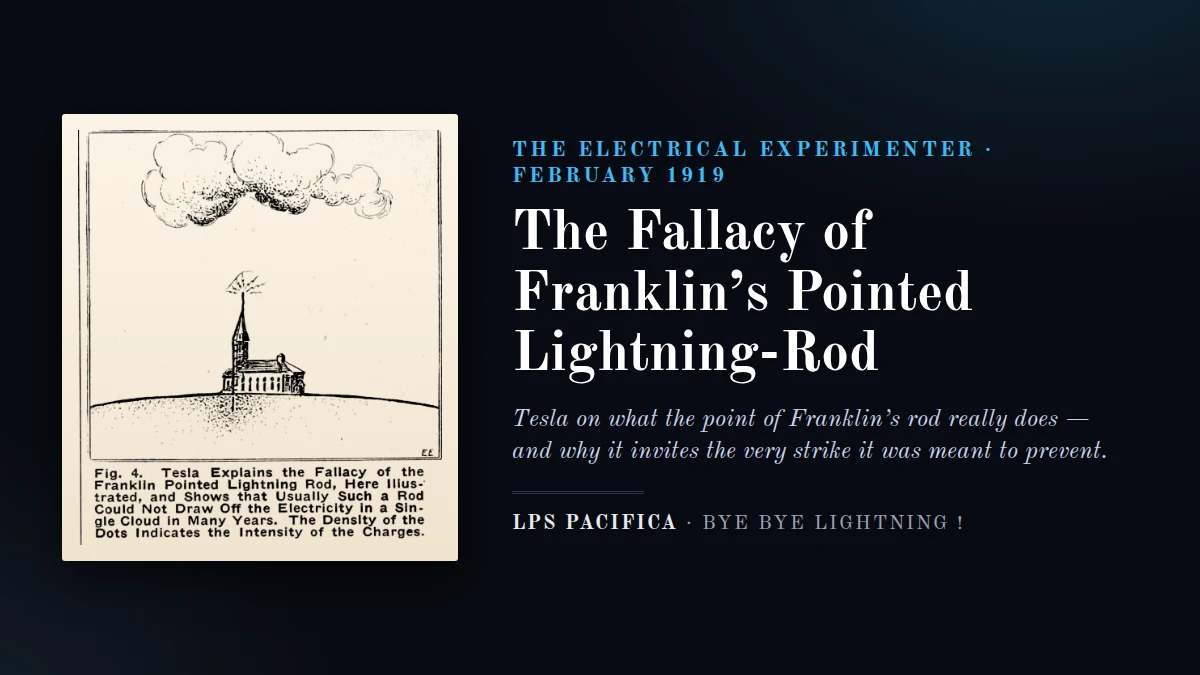
The Fallacy of Franklin’s Pointed Lightning-Rod
Tesla’s 1919 essay on Franklin’s pointed rod: the point drains almost nothing, invites the strike — a rounded terminal is what repels it.
Read the archive →Not sure what your building needs? Send us a photo of the roof and the surrounding area — we tell you what we see, free of charge.
Contact us